
Newsroom — AI
AI wrote it. But does it sound like you?
70% of people say it's important AI writing sounds like them. Only 12% think it does. The fix isn't a bigger model — it's routing each paragraph to the voice you actually need.
By VewMet — October 2026 — 4 min read
Contents
You know that feeling
You read the paragraph back and it's… fine. Grammar's fine. Structure's fine. But it doesn't sound like you. It sounds like a very polite intern who read too many LinkedIn posts.
You're not imagining it. And you're not alone.
A Pipedafy survey from last month found that 70% of people who use AI for communications say it's important the output sounds like them — and 46% call it essential, not nice-to-have. Flip it around: about 30% say AI content feels generic or robotic. Only 12% think AI-written material matches human quality.
So here's the thing. We've spent two years arguing about whether AI writes well. Almost nobody asked whether it writes like you.
Why everything sounds the same
It's not an accident. Most AI writing tools give you one model, tuned one way, with one house voice. You get the same flattened, helpful, slightly-too-chipper tone whether you're drafting a research abstract, a team update, or a note to a friend. The industry's answer has been a bigger model. As if the problem is intelligence. It's not. The problem is you only get one voice, and it's not yours.
Some tools let you pick a "tone" — professional, casual, friendly. That's a costume draped over the same voice. It fools nobody, least of all the people who actually know how you write.
Your voice isn't one voice
Here's what nobody talks about: you don't have one writing voice either. The way you write a technical spec isn't the way you write a launch note. Your research voice, your team-update voice, your 2am-idea-dump voice — they're different registers, and you switch between them without thinking.
So why does your AI tool get exactly one?
This is where multi-model routing stops being a spec-sheet bullet and starts being the whole point. Different models genuinely write differently — different rhythms, different vocabularies, different instincts about structure. If you can route each paragraph to the model that matches the voice you need there, you're not fighting the tool anymore. You're conducting it.
That's what inkk.ai does. Fifty-plus models through OpenRouter, routed independently for the editor and the chat copilot. Draft the spec with the precise one. Write the launch note with the punchy one. And because every edit carries caret-level attribution, you can always see which model wrote which line — so when a paragraph doesn't sound like you, you know exactly who to blame.
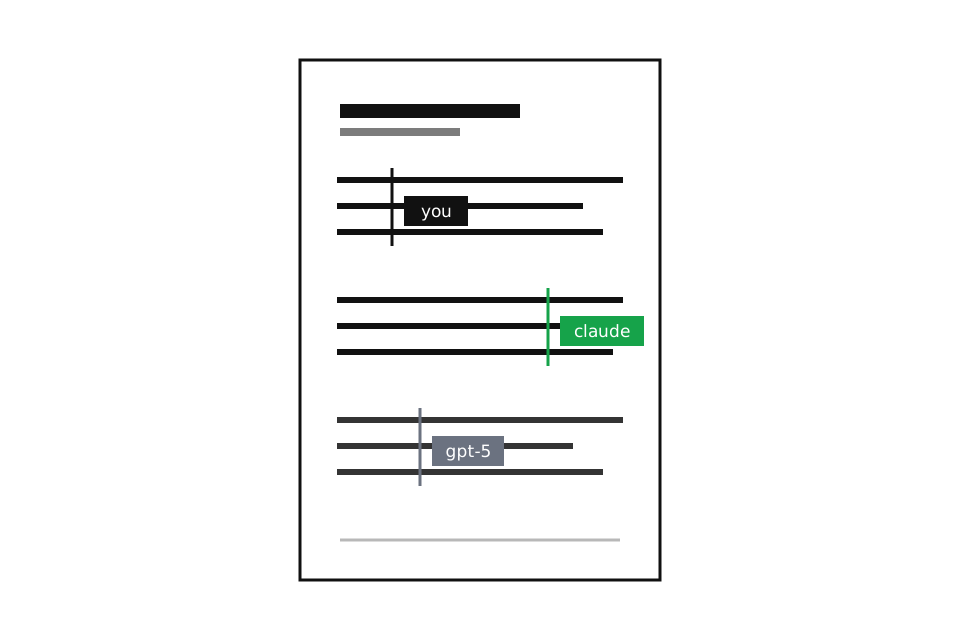
The quiet superpower: knowing who wrote what
Attribution sounds like a compliance feature. It's actually a voice feature.
When you can see which model wrote which line right next to the lines you drafted yourself, editing stops being archaeology. You don't re-read the whole doc wondering which parts are yours. You go straight to the robot's paragraphs and fix the voice — or swap the model and regenerate just that stretch.
78.7% of developers say source attribution matters when evaluating AI output (Stack Overflow, this week). They're right, but most of them are thinking about trust and provenance. The everyday win is simpler: it makes the edit fast. You spend hours a week fixing the robot's homework — you might as well know which homework is the robot's.
So what?
The AI writing conversation has been stuck on a weird question: can the machine write like a human? Wrong question. The right one is: can it write like you, in the specific register you need, for this paragraph, right now?
One model, one voice, forever — that's the old deal. The new one is: as many voices as you have, routed per paragraph, with your name still on the byline.
That's the whole reason we built it that way. The page remembers who wrote what — including which version of you.
# Ask inkk.ai's chat copilot to rewrite one paragraph in another model's voice.
# Illustrative — see inkk.ai for the current API shape.
curl -X POST "https://inkk.ai/api/1/appendHTML" \
  -H "Authorization: Bearer $INKK_API_KEY" \
  -H "Content-Type: application/json" \
  -d '{"documentId": "launch-notes", "html": "<p data-voice=\"claude\">Second draft.</p>"}'
Start writing at [inkk.ai](https://inkk.ai) — the page remembers who wrote what.
Keep reading
AI — October 2026
AI for computer use
AI agents can now operate a computer the way a person does — seeing the screen, moving the mouse, typing. What that changes, where it breaks, and why the agent belongs inside the work, not on top of the operating system.
Engineering — October 2026
Jev: the System One model
TypeSafe AI's Jev doesn't generate text. It answers typed questions with calibrated probabilities — fast, cheap judgment for agent stacks. Why the missing layer in AI products isn't a bigger model, it's a faster decider.
Product — February 2025
inkk.ai Marketplace is live
Our AI agent marketplace launched in February 2025 — AI agents that take care of all your writing needs.
Product — October 2026
OpenAI just announced Pages. We've been shipping it since February.
OpenAI's Pages is a collaborative AI document editor. Ours has been live since February — with caret-level attribution, in-document calls, and zero vendor lock-in.
Product
VewMet Calls
Imagine AI joining your calls as a participant — listening, moderating, and contributing in near real-time. Launching soon.