
Newsroom — Product
OpenAI just announced Pages. We've been shipping it since February.
OpenAI's Pages is a collaborative AI document editor. Ours has been live since February — with caret-level attribution, in-document calls, and zero vendor lock-in.
By VewMet — October 2026 — 4 min read
What OpenAI announced
At DevDay, OpenAI took direct aim at the productivity suite. ChatGPT Pages is a collaborative document editor in the Notion mould: multiple people editing together, AI revising alongside them, documents living inside ChatGPT instead of a separate app. Spaces extends the idea to team workspaces, and Slides are coming soon. The target is explicit — Microsoft 365, Google Workspace, and Notion.
The fine print matters. Pages is for paid ChatGPT plans, and on mobile it is read-and-share only for now. But the signal is unmistakable: the document is becoming the AI workspace. Gartner's forecast, cited around the launch, puts enterprise AI-assistant spending at $17B in 2025 rising to $71B in 2030. The industry has finally decided that writing is where the AI money goes.
It was not a lonely conclusion. Notion bolted AI onto the page years ago, Google is weaving Gemini through Workspace, and Microsoft keeps pushing Copilot deeper into Word. Every major platform has independently arrived at the same thesis: the document — not the chat window — is where knowledge work actually happens, so the AI has to live there. OpenAI's entry just makes the consensus official.
We've been shipping this since February
Here is the part we get to say plainly: inkk.ai has been a real-time collaborative AI writing workspace since February 2025. Type @ai anywhere in a document and the model answers inline — while collaborators, agents, and calls work the same line, not separate tabs.
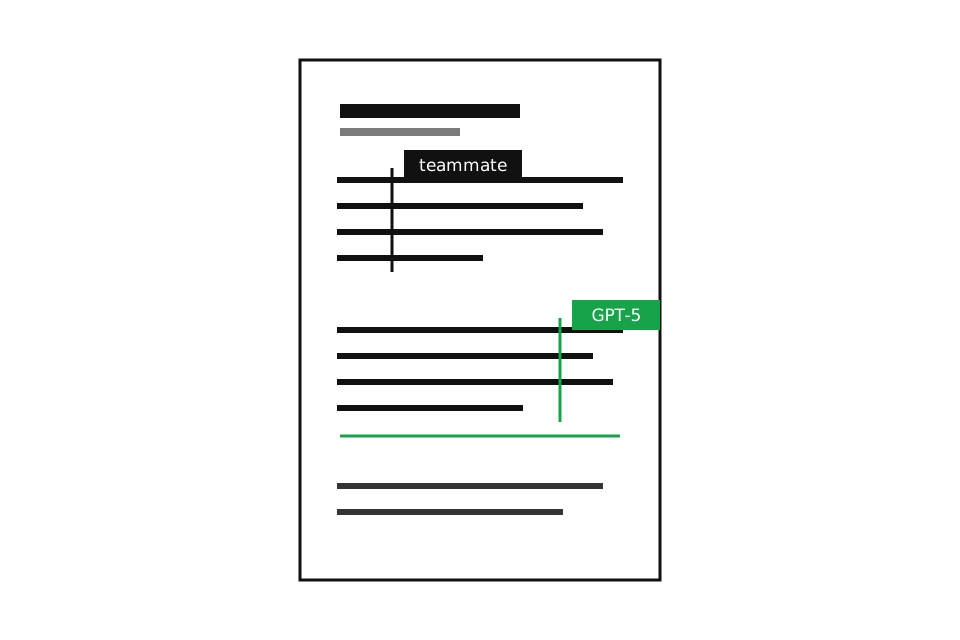
The difference was never the chatbot. It was the document remembering. Every keystroke in inkk.ai carries its author: a teammate drafts lines 1–14, GPT-5 inserts a block at line 15, and the page remembers which was which. Caret-level attribution tracks AI versus human writing dynamically as the document grows, and character-level revision history keeps every edit, every author, and every timestamped version.
Underneath that sits architecture most editors still don't have: separate AI engines for the editor and the chat copilot, multi-provider model routing with zero vendor lock-in, and unmetered free community models that never touch a token balance. Group workspaces organise documents like a book, with per-page view, edit, and comment control for admins. And the calls happen inside the document — built-in peer-to-peer audio and video, no third-party app, no context switch. White-label embedding and a REST API carry the whole thing into other products.
That February launch was not a demo, either. The inkk.ai Marketplace opened the same month: a catalogue of AI agents that take care of writing needs — research, drafting, review — picked from inside the document, working in the same line. Teams that write together, students and researchers generating live interactive simulations, builders embedding the whole editor into their own products: they have been doing this on inkk.ai while the category was still called a chatbot wrapper.
The honest comparison
Let's not dodge the obvious. OpenAI's distribution advantage is enormous: hundreds of millions of people already live inside ChatGPT, and Pages arrives as a tab they already have open. No startup landing page competes with that. Anyone telling you distribution doesn't matter is selling something.
But distribution is not the product. The document is not a chat log with formatting — it is the workspace where thinking happens, and the details of that workspace are where we have a twenty-month head start: attribution down to the keystroke, model choice instead of model lock-in, calls without leaving the page, and a free tier that doesn't meter curiosity.
And credit where it is due: OpenAI dragging multiplayer AI editing into the mainstream overnight is the fastest category education we have ever had. Every team that tries Pages and then asks "can the AI and my team actually write in the same line?" is a team ready for what we built.
There is also a pricing story nobody at DevDay mentioned. Pages sits behind paid ChatGPT plans — the AI document is a premium upsell. Our bet has always been the opposite: unmetered free community models, a free tier that doesn't meter curiosity, Pro only when you want premium models with tokens that never expire. And where Pages locks you to one provider's models, inkk.ai routes across providers — GPT, Gemini, DeepSeek, Llama — because the document should outlive any single lab's fortunes.
If we are being honest about what we'd steal: Pages' onboarding. One click inside an app two hundred million people already open beats any landing page we will ever build. That is a distribution problem, not a product problem — and it is the one we are now solving.
Try it
The pitch is simple: open a document, invite your team, type @ai, and watch the page remember who wrote what. Free to explore — no token maths required to start.
# Append content to a live inkk.ai document over REST.
# Illustrative — see inkk.ai for the current API shape.
curl -X POST "https://inkk.ai/api/1/appendHTML" \
  -H "Authorization: Bearer $INKK_API_KEY" \
  -H "Content-Type: application/json" \
  -d '{"documentId": "launch-notes", "html": "<h2>Draft</h2><p>First pass.</p>"}'
Start writing at [inkk.ai](https://inkk.ai) — the page remembers who wrote what.
Keep reading
AI — October 2026
AI for computer use
AI agents can now operate a computer the way a person does — seeing the screen, moving the mouse, typing. What that changes, where it breaks, and why the agent belongs inside the work, not on top of the operating system.
Engineering — October 2026
Jev: the System One model
TypeSafe AI's Jev doesn't generate text. It answers typed questions with calibrated probabilities — fast, cheap judgment for agent stacks. Why the missing layer in AI products isn't a bigger model, it's a faster decider.
Product — February 2025
inkk.ai Marketplace is live
Our AI agent marketplace launched in February 2025 — AI agents that take care of all your writing needs.
Product
VewMet Calls
Imagine AI joining your calls as a participant — listening, moderating, and contributing in near real-time. Launching soon.